We have all been there. Your little one finally zips up their jacket or brings you a drawing they have worked on for twenty minutes, and those two little words just fly out of our mouths: “Good job!”
It is our reflex. We want them to feel seen, loved, and encouraged.
But in the world of Montessori, we try to take a breath and look a little deeper. Dr. Maria Montessori observed that children have what she called an Absorbent Mind. From birth to age six, they are like little sponges, soaking up everything in their environment, including the way we value their work. When we constantly label everything as a “good job,” our children can start to rely on our approval rather than their own sense of accomplishment.
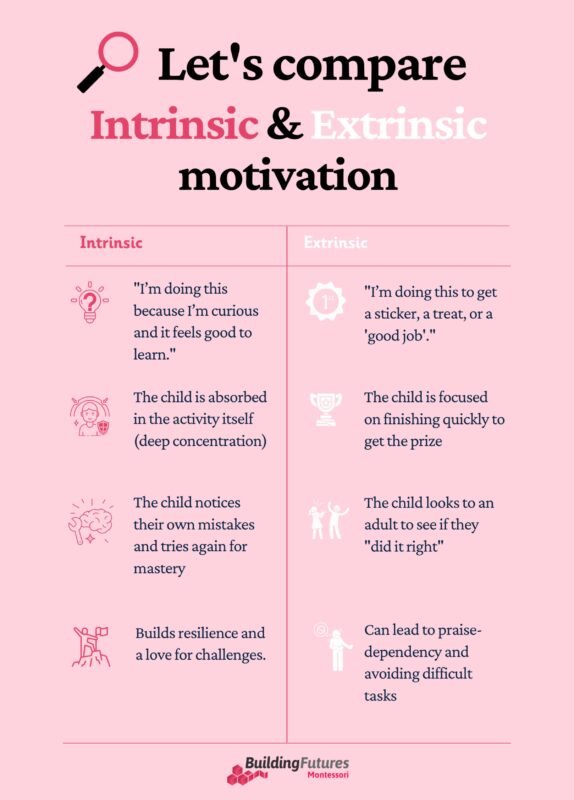
In Montessori theory, this is the difference between extrinsic and intrinsic motivation. Intrinsic motivation is that spark that comes from within, where a child engages in an activity simply because it is interesting, satisfying, or challenging. It is the joy of the process itself, like a toddler who repeats a task over and over just to master the movement. Extrinsic motivation, on the other hand, relies on outside rewards like stickers, treats, or even a “good job” to drive behaviour. While those external carrots might work in the short term, the goal in Montessori is to protect that inner drive so children learn to value their own progress rather than just working for an audience. We want to raise kids who are driven by a deep, internal desire to master a skill, not kids who are always looking at us to see if they earned a “verbal sticker.”
Shifting away from this habit is honestly hard, but it feels so much more connected once you start. Here are a few ways I have been trying to change the conversation in my own home.
1. Describe what you see (The Power of Observation)
One of the most important tools in a Montessori parent’s kit is observation. Instead of judging the end result, try being a mirror for their effort. When you describe what they did, it shows you were actually paying attention.
- If they show you a painting, you might say, “I see you used a lot of green and made really long lines across the page.”
- The Goal: This honours their Sensitive Period for order or detail. It opens up a conversation instead of just closing it with a compliment.
2. Focus on the effort (The process over the product)
In a Montessori classroom, the “work” is the “reward”. The magic usually happens in the middle of the task, not just at the end.
- If your child finally finishes a tricky puzzle: You could say, “You tried so many different ways to fit those pieces together until you found the right spot.”
- The Goal: This teaches them that effort and persistence are the parts that actually matter, nurturing a lifelong love of learning.
3. Ask them how they feel (Cultivating self-evaluation)
This is the biggest one for me. We want our children to be the judges of their own success.
- Instead of “I’m so proud”: Try asking, “How did it feel to climb that big ladder?” or simply saying, “You look so proud of yourself!”
- The Goal: This helps them check in with their own heart and builds independence, which is the cornerstone of Montessori practice.
4. Show the ripple effect (Grace and Courtesy)
When they do something kind or helpful, show them the “why” behind it through what Montessori called Grace and Courtesy.
- Instead of a generic praise: You could say, “Thank you for helping. Now our floor is clear, and we have space to play a game together.”
- The Goal: It helps them see that their actions have a real, positive impact on the community, starting right at home.
Breaking the “Good job” habit takes time, and I still catch myself saying it all the time. But when I manage to slow down and really notice the effort my child is putting in, the connection feels so much deeper. It is less about being a judge and more about being a witness to their growing world.